

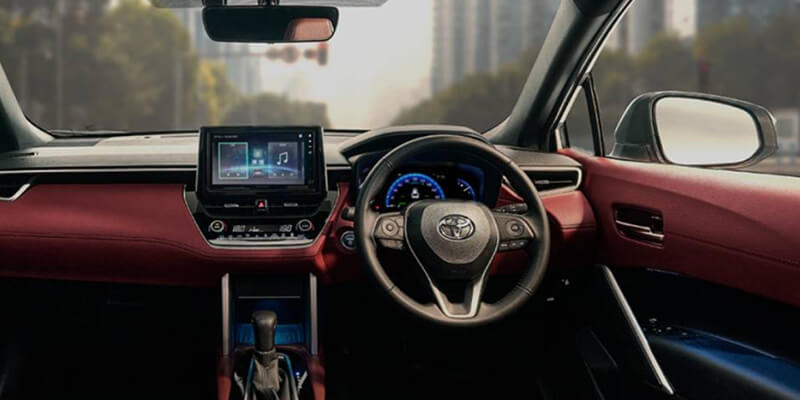
Exploring the Toyota Navigation System Features
Written by Abrar FazlaniThe Peerless Toyota Navigation System
Although many purists still argue that a vehicle only needs a functioning engine and wheels to move, many drivers tend to differ. They are now accustomed to a user-friendly touchscreen on the dashboard of their cars. It serves as a medium for connectivity, safety, and convenience. The brains behind this revolutionary advancement are the Toyota navigation system. This piece of tech is constantly evolving to keep improving the passenger’s journey by making it more safe, smoother, and reliable.
Its features include turn-by-turn directions to real-time traffic data. The Toyota navigation system has left behind the limitations of a static map. The company’s efforts to keep improving its vehicles are not only through its performance on the road but also inside it as well. With constant improvement in mind, the automobile juggernaut has cemented and expanded its place in the industry over the years.
What Is A Navigation System In Cars
Before we can truly appreciate the brilliance of the Toyota navigation system, we first need to understand the basics. Firstly, what is a navigation system, and why is it so important to many drivers?
To put it simply, it’s an onboard digital tool using Global Positioning System (GPS) satellites to determine your vehicle’s position. Then, it uses this information to guide you to a destination. Moreover, recent iterations combine GPS data with stored or cloud-based maps. Hence, helping drivers with real-time updates on routes, points of interest, speed limits, and traffic.
- Accurate route guidance to destinations without needing a mobile signal.
- Voice instructions for hands-free driving.
- Traffic alerts and rerouting, helping you avoid congestion.
- Integration with vehicle data, allowing smarter route planning based on fuel range, terrain, or driving mode.
Like with everything that Toyota does, it takes an emerging concept and amplifies its advantages. The Toyota navigation system has utilized the fundamental aspects of it and topped that with its own connected ecosystem. Hence, creating the Toyota navigation system that betters both its performance and aesthetics.
The Evolution of the Toyota Navigation System
Now that we’ve established the impressiveness of the Toyota navigation system, let’s look at how it’s evolved over the years. Its progress has been nothing short of dramatic. Earlier models offered basic map guidance via CD or DVD-based map databases.
However, the more recent ones offer real-time data, touchscreen interfaces, and even cloud connectivity. Hence, making its efficacy second to none in the market. Moreover, all this progress is on the back of extensive market research. This is to make sure that each advancement betters the passengers’ experience.
Let’s take a closer look at the advancements of the Toyota navigation system over the years.
- Built-in GPS with Onboard Maps: The older models sported a rather simplistic look compared to today. They featured built-in navigation using physical media (like DVDs) to store map data. Although functional, it faced multiple issues. These include updates requiring manual installation via dealer-provided discs.
- Touchscreen and Voice Control: Then came the advent of the Entune infotainment suite. A revolutionary advancement that spurred the company to begin integrating voice recognition and touch controls. Thus, it enabled drivers to search for destinations hands-free, making them feel more at ease than before.
- Connected Navigation: Then, the entire digital landscape changed when cloud-based navigation entered the equation. The Toyota navigation system integrated it with its own connected services. Now, access to live traffic updates, weather forecasts, fuel prices, and points of interest (POIs) is available in real time. Hence, making journeys not only smooth but adaptable as well.
- Integrated Safety and Driver Assistance: The most recent iteration of the Toyota navigation system interacts with the Toyota Safety Sense. The latter was developed to keep the drivers more safe than ever before. It accomplishes this by providing speed limit alerts, lane guidance, and adaptive route planning based on driving conditions. The company has always put the safety of its customers before anything else. This advancement is a testament to the commitment.
Toyota Navigation System Key Features
The Toyota navigation system is a mechanism to combine accuracy, design, and driver convenience. This holds for a Toyota Corolla navigation system as well as a Revo. All of these products have some standout features that have captured the minds of many around the world. Let’s take a deep dive into what they are and what they offer.
- Turn-by-Turn Voice Guidance: This one seems self-explanatory. This feature makes sure the driver receives clear visuals and audible directions. Thus, providing both cues prevents any mistakes. Hence, making it easy to understand and use.
- Real-Time Traffic and Rerouting: The newer cloud-based models are constantly working on the best routes to take. It achieves this by monitoring traffic flow in the area. Then, it makes the decision on the best route that saves both time and fuel.
- Lane Level Guidance: This feature holds immense importance for newer drivers or those who require assistance. Its display shows which lane to stay in for an upcoming turn or exit. Thus, reducing any traffic accidents or jams, specifically in complex intersections
- Speed Limit and Camera Alerts: Again, this is self-explanatory. It provides current speed limits and warns of red lights or speed cameras. This is dependent on the variants available in the market.
- Offline Map Access: With increasing users around the world, sometimes the internet connectivity is disrupted or lost. However, Toyota’s onboard maps keep functioning offline as well. Hence, making sure that the driver is never lost or stranded awaiting directions.
- Voice Command Integration: Using audio commands allows the driver to not take their eyes off the road whilst driving and stay informed. Moreover, it is also useful for people who are technologically challenged. Hence, making the Toyota navigation system inclusive and accessible.
Conclusion
At the end of the day, it is undeniable that the Toyota navigation system has been a huge success. What’s promising, the company’s commitment to keep evolving. By keeping up with the advancements of time, it can provide its customers with nothing but the best. This includes both the vehicle’s performance on the road and the features inside it. A mentality that Toyota thrives on.
FAQs
A. GPS (Global Positioning System) in cars works by receiving signals from multiple satellites orbiting the Earth. The system calculates your exact position through triangulation and displays your route on the car’s screen. Moreover, it even provides updates in real time as you drive.
A. Toyota’s built-in navigation is ideal for offline reliability and full integration with your vehicle’s sensors and safety systems. On the other hand, Android Auto offers real-time updates and the familiar Google Maps interface. However, it requires a connected smartphone.