

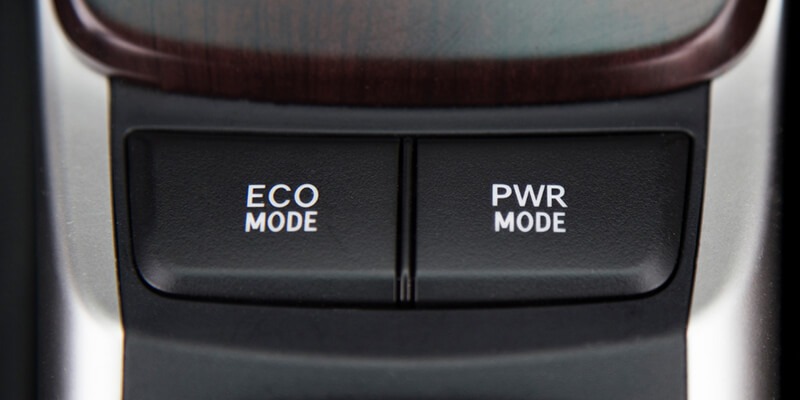
What is Toyota Eco Mode and How Does it Work?
Written by Moosa RazaToyota’s Social Responsibility
One of the many reasons Toyota’s legacy has endured the test of time is its ability to evolve with time. It has constantly adjusted its vehicles as well as its policies to align with consumer demands. Moreover, it has also pushed itself to offer its customers products and services unlike anything they have witnessed before. Hence, when people started educating themselves on the impacts of their consumption on the environment, so did the company. That is what gave birth to the Toyota eco mode in their vehicles.
Furthermore, today’s drivers do not have the same priorities as people had a couple of decades ago. In contrast to only speed and performance, people now look for fuel efficiency, lower emissions, and smarter driving. With the fuel prices constantly fluctuating due to various geopolitical reasons, drivers today want intelligent systems. These are designed to help them save fuel without having to sacrifice their comfort or damage the environment. Thus, this green feature has become an instant hit. It enhances performance whilst helping people remain responsible members of society.
What Is Toyota Eco Mode?
Now, before we can examine the various features that this mode offers, let’s first understand what it is. In essence, it is a fuel-saving driving mode that adjusts how the vehicle responds to driver inputs. Thereby, reducing fuel consumption and emissions without requiring the driver’s manual input. Moreover, when it is activated, the vehicle’s engine, transmission, throttle response, and climate control systems are tuned differently. They focus on efficiency rather than performance.
Having said that, it is important to mention that this green feature does not limit the vehicle’s performance. Rather, it is still able to reach highway speeds or climb hills. Instead, it provides smooth acceleration, optimizes gear shifts, and limits energy wastage. Moreover, the hybrid and electric models are equipped with this environmentally beneficial feature as well. Here, electric operation is prioritized whenever possible.
What Does the Toyota Eco Mode Do?
Often, the drivers are more focused on the specifics of what these features can offer to them. However, the answer to that question is not as straightforward as it appears. The reason behind this is that the answer varies depending on the vehicle’s composition. Its features are different for a gasoline powered, hybrid, and plug-in hybrid. However, the core elements of its structure remain the same.
- Softer Throttle Response: The green feature is able to reduce the engine’s aggressiveness when responding to the accelerator. As a result, the likelihood of sudden bursts of fuel usage is limited. Thereby, providing a smoother acceleration experience.
- Optimized Transmission Behavior: In automatic transmissions, it adjusts shift points so the vehicle upshifts earlier. Hence, keeping engine RPMs lower whilst also improving fuel efficiency.
- Reduced Climate Control Load: The green feature modifies heating and cooling behavior. It accomplishes this by using eco heat cool logic. Thus, limiting the energy consumption by the air conditioning or heater without significantly affecting comfort.
- Improved Hybrid Energy Management: When talking about hybrids, the green feature prioritizes electric motor usage and regenerative braking. Thus, it reduces reliance on the gasoline engine.
Examining How It Works in Different Toyota Vehicles
Now we know what it is and its functionality, let’s see how it works in different vehicles.
- Gasoline Vehicles: For these types of vehicles, the focus remains mostly on throttle response, transmission shift timing, and climate control efficiency. Additionally, the fuel savings occur primarily as a result of smoother acceleration and reduced engine load.
- Hybrid Vehicles: For hybrid vehicles, it functions significantly differently. The green feature plays a larger and more impactful role here. It encourages the following aspect of a vehicle’s performance:
- More electric only driving at low speeds
- Earlier engine shut off when coasting
- More effective regenerative braking
- Plug In Hybrids: Here, it functions by working alongside battery management systems. This helps it to extend electric range while minimizing fuel use.
Does It Improve Fuel Efficiency?
To put it simply – Yes. It consistently improves the fuel efficiency of a vehicle. This holds particularly true for in-city driving and stop-and-go traffic. That being said, various real-world factors influence fuel efficiency levels. These are as follows:
Given all these conditions are favorable, a driver may see an average 5% to 15% improvement in fuel economy. On the driver’s side, by avoiding aggressive acceleration and frequent hard braking, they can play their part as well.
- Driving habits
- Traffic conditions
- Terrain
- Weather
- Vehicle type
Does It Extend Battery Life?
The most concerning aspect for hybrid owners is how new features impact the battery life. Here, the short answer is yes – although it occurs indirectly. Though its green feature does not physically change the battery chemistry or capacity, it reduces stress on the battery system. It achieves this by focusing on the following:
- Encouraging smoother power delivery
- Reducing rapid charge discharge cycles
- Optimizing regenerative braking
- Minimizing unnecessary electrical load
Conclusion
Summing it all up, there’s no denying that the Toyota eco mode has become a global hit since its introduction. Drivers find that not only does it provide better performance but keeps the environment intact as well. That’s why there is no surprise that it has become a staple in almost every new model the Japanese giants introduce in the market.
Its presence reassures people that Toyota’s responsibility towards the environment remains a priority, not an option. Thus, cementing its place as a main player in the market for years to come. Now, drivers can look forward to new releases without having to worry about the environmental impacts of their decisions.
FAQs
A: It adjusts throttle response, transmission behavior, and climate control settings. This helps to reduce fuel consumption and emissions.
A: It can help extend battery life indirectly. It achieves this by reducing electrical load and limiting aggressive charge and discharge cycles in hybrid vehicles.